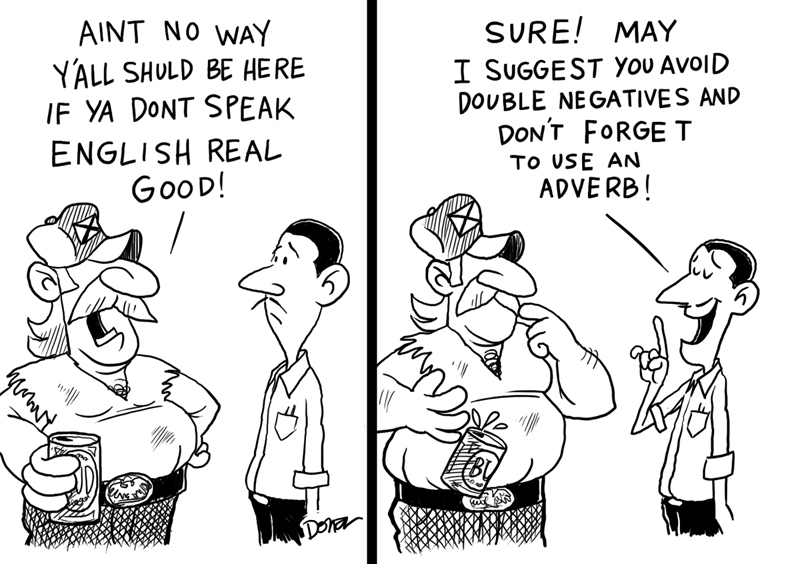
This political cartoon caught my eye and really reminded me of the book written by Leo Chavez, "The Latino Threat." This cartoon really personifies the argument that Chavez was making in his book; how Latinos have been alienated and labeled to be one way. I love how this cartoon represents the stereotype and then so quickly rejects it. It is an excellent example of many people's attitudes towards immigrants and further, an example of how such attitudes are quite unjust.
Saturday, December 11, 2010
Sunday, December 5, 2010
The United States 'Volatile' Population
I found an article that was interesting regarding immigration and its effects on the population of the United States. According to Haya El Nasser, the nation's population was determined to be 281.4 million in the 2000 Census, but early estimates of the 2010 Census indicate lower numbers; 305.7 million people.
This year is the first one that the agency has put out five estimates "based on Census survey and administrative records such as births, deaths and immigration" (Nasser). These estimates, according to Nasser, are reflective of the widespread changes regarding immigration that have taken place between 2000 and 2010.
I think it is interesting that the Census is reporting smaller population numbers for the 2010 Census and wonder just how much of the change can be attributed to legislation like Arizona's SB 1070. It will be interesting to see the actual results of the Census later this month and just how they correlate to changes that have taken place over the last decade.
Follow-up
On December 4, Scott Wong wrote a short piece regarding the DREAM Act and how the Senate would be holding a vote in the coming week on it. The votes being held next week in addition to the DREAM Act are on "immigration, a health care bill for 9/11 rescue workers and a cost-of-living adjustment for seniors" (Wong). According to Reid, it "leaves a pretty clear path to tackle larger issues like tax cuts, a government spending bill, ratification of the START nuclear-arms treaty, and possibly the massive defense bill which includes the repeal of "don't ask, don't tell" policy" (Wong).
The DREAM Act must receive sixty votes in order to advance in the Senate, but a number or Republicans have vowed this week that they would "block any legislation brought up before the chamber deals with expiring Bush-era tax cuts and funding for government operations" (Wong). Wong also pointed out that "in recent days, calls from the Obama administration, the Hispanic community and immigrant advocates" have intensified in urging congressional action on the bill.
Revisiting the DREAM Act
Brian Montopoli wrote an article entitled, "Is There a Last Gasp for Immigration Reform?" on December 1. Within his article he discusses how the DREAM Act is essential to any immigration reform and talks about what the Democrats have to do to get the vote to the Senate. According to Montopoli, "The DREAM Act is a major priority of Hispanic groups, who represent a growing and crucial voting bloc. [He goes on to say that] without them Senate Majority Leader Harry Reid, among other Western Democrats, would now be preparing for retirement."
It is going to be a challenge to bring the DREAM Act for a vote in the Senate, "Republicans say they will block any and all other legislation until the Bush tax cuts have been extended and the government, which runs out of money on Friday, has been funded" (Montopoli). The bill needs sixty votes in order to pass and that is still in the air, at least two of the Democrats will likely vote against it which will only offset the two Republicans that seem to support the bill. In order for Reid to overcome a filibuster two more Republicans would have to vote for it. It is also not yet a "sure thing in the House: Democrat Steny Hoyer said today that he has not yet determined whether or not is will come to the floor, and even if it does, expect a number of Democrats to vote against it" (Montopoli).
Although it seems unlikely that it will pass as of right now, I do think that the Democrats should continue to push for the Senate and House vote. I think that if it is passed it would prove to be quite beneficial to the United States. It would be providing a path to citizenship to those people that have been in America since they were young children, have not committed any serious crimes, and have gone to school with the ultimate goal of college or the military. It seems to me that these people would be ones that we want to be American citizens, people who are quite valuable to society as a whole.
Monday, November 29, 2010
Prince William Immigration Law
Three years ago Prince William County in Virgina passed an ordinance "which initially required police to check the status of detainees they suspected of being undocumented immigrants" (Bahrampour). This ordinance received many of the same responses that the Arizona law does. It has "raised ire among immigrant advocates and [has drawn] sharp criticism from the county police chief, who said it would cost taxpayers more, lead to allegations of racism and erode police-community relations" (Bahrampour).
The ordinance was modified in 2008 as it was charged as "unconstitutional and could lead to racial profiling" (Bahrampour). The modification directed officers to question all criminal suspects regarding their immigration status once arrested, rather than only questioning those suspected of being illegal immigrants.
On November 17, 2010 an article was published looking into the Prince William policy and the effect it has had over the years. According to a report for the University of Virginia, the policy "appears to have had some effect, as the growth of the county's Hispanic population now lags behind that of other jurisdictions" (Buske).
"The three-year, $385,000 study- released Tuesday by the university's Center for Survey Research- also found that the country's noncitizen Hispanic population, legal and illegal, dropped by 7,700 from 2006 to 2008, and that illegal immigrants accounted for 2,000 to 6,000 of that decline" (Burske).
Prior to the ordinance, the county had significant growth in its Hispanic population, in fact, it "almost doubled from 2000 to 2005" (Burske). Although growth leveled off in the county once the policy was implemented, growth continued in Washington overall. "The report states that Hispanics are avoiding Prince William and that the county, therefore, did not succeed in implementing an immigration policy without damaging its reputation as a welcoming place to live" (Burske).
The report goes on to state that while the policy has reduced the number of illegal immigrants in Prince William, not all of the effects have been "good". "Initial distrust of and dissatisfaction with county government has subsided among Hispanic residents of Prince William. The change in attitude can be attributed to adjustments in the policy, community outreach and the decline in attention paid by the media and groups opposing illegal immigration" (Burske).
Although "the study found that initial fears about racial profiling did not materialize and that only one lawsuit that mentions racial profiling has surfaced" (Burske) (which was ultimately dismissed in court), a Spanish radio show host voiced his disagreements. Accroding to Aragon, " There was racial profiling, and that's the reason why everyone started to leave [and that] the Hispanic businesses and malls are empty. [He said] you used to see 100 people at the shopping center, and after the resolution, you'd see five. You noticed the difference" (Burske).
Overall, it is interesting to read the effects that such a policy has had over the span of three years. I think it will be quite interesting to look at Arizona statistics after a few years.
The ordinance was modified in 2008 as it was charged as "unconstitutional and could lead to racial profiling" (Bahrampour). The modification directed officers to question all criminal suspects regarding their immigration status once arrested, rather than only questioning those suspected of being illegal immigrants.
On November 17, 2010 an article was published looking into the Prince William policy and the effect it has had over the years. According to a report for the University of Virginia, the policy "appears to have had some effect, as the growth of the county's Hispanic population now lags behind that of other jurisdictions" (Buske).
"The three-year, $385,000 study- released Tuesday by the university's Center for Survey Research- also found that the country's noncitizen Hispanic population, legal and illegal, dropped by 7,700 from 2006 to 2008, and that illegal immigrants accounted for 2,000 to 6,000 of that decline" (Burske).
Prior to the ordinance, the county had significant growth in its Hispanic population, in fact, it "almost doubled from 2000 to 2005" (Burske). Although growth leveled off in the county once the policy was implemented, growth continued in Washington overall. "The report states that Hispanics are avoiding Prince William and that the county, therefore, did not succeed in implementing an immigration policy without damaging its reputation as a welcoming place to live" (Burske).
The report goes on to state that while the policy has reduced the number of illegal immigrants in Prince William, not all of the effects have been "good". "Initial distrust of and dissatisfaction with county government has subsided among Hispanic residents of Prince William. The change in attitude can be attributed to adjustments in the policy, community outreach and the decline in attention paid by the media and groups opposing illegal immigration" (Burske).
Although "the study found that initial fears about racial profiling did not materialize and that only one lawsuit that mentions racial profiling has surfaced" (Burske) (which was ultimately dismissed in court), a Spanish radio show host voiced his disagreements. Accroding to Aragon, " There was racial profiling, and that's the reason why everyone started to leave [and that] the Hispanic businesses and malls are empty. [He said] you used to see 100 people at the shopping center, and after the resolution, you'd see five. You noticed the difference" (Burske).
Overall, it is interesting to read the effects that such a policy has had over the span of three years. I think it will be quite interesting to look at Arizona statistics after a few years.
Recent High School Graduate
In Reading, Ohio 18 year old Bernard Pastor who graduated last year from high school was arrested last week after he was caught driving without a license. According to Pastor's lawyer, Firooz Namei "Pastor and his family came to America from Guatemala when he was three for religious asylum but was denied in 2001. His family has been in the appeal process since... he has not been in contact with the family because they are in hiding for fear of also being taken into ICE custody and possibly deported" (Fox).
If the Department of Homeland Security agrees to reopen the family's case, he will be able to remain here. Pastor, according to the school superintendent, "was a 4.0 student, played soccer and never caused any trouble." Pastor's potential removal was "delayed Tuesday night after local politicians urged the government to reconsider his case" (Fox).
"The DREAM Act would allow a six year period for young undocumented immigrants to earn a permanent visa and work toward a U.S. citizenship" (Fox). According to Congressman Steve Driehaus, (unseated by Republican Steve Chabot in midterms) the legislation would protect people like Pastor who pose no threat to the country- unlike those criminally convicted that I discussed in a previous entry.
I hope that Pastor is allowed to remain in the country, he has been here since he was three, he has attended school here and ought to be granted citizenship. If he is granted citizenship he will be able to further contribute to society through paying taxes and being a legal, active citizen.
Sunday, November 21, 2010
Subscribe to:
Posts (Atom)