On December 10, 2010, the Associated Press published an article entitled, "Judge dismissed part of challenge to Arizona law." Although governor Jan Brewer requested that challenges to some of SB 1070's most controversial sections and she was denied, some parts of the U.S. Department of Justice's challenges to the new law were dismissed.
The U.S. District Judge, Susan Bolton ruled on Friday and ultimately "struck down the federal government's challenge to the portion of the law that prohibits the transport of illegal immigrants" (2010). It will be interesting to read the rulings that will be made over the law's most controversial sections in the weeks to come.
Monday, December 13, 2010


Ohio Lawyer Requests Teen's Deportation be Delayed
Dan Sewell published a report on Bernard Pastor today, he is an illegal immigrant from Guatemala who has been in the United States since the age of three. Recently, he got into a minor car accident which is how police discovered that he was not a United States citizen. He attends high school in Cincinnati, Ohio and is in the top of his class. His attorney, David Leopold is arguing that "there is no urgency to remove 18-year-old Bernard Pastor from the country where he has lived since the age 3" (Sewell, 2010).
Leopold is the head of the Immigration Lawyers Association and was contacted by supporters of Pastor as well as immigration reform advocates a week ago regarding this case. He has undertaken this case without fee and has already "a formal request that his deportation be deferred" (Sewell, 2010).
Although I posted recently regarding this case, I think it is worth describing the situation again. Pastor and his family fled Guatemala as his father faced persecution, he was denied citizenship a few years ago. According to Pastor, "he considers himself an American, speaks little Spanish and hardly knows anyone in Guatemala" (Sewell, 2010).
Pastor is now being referred to as a poster child for the proposed DREAM Act that is currently being debated in Congress. If the bill were to pass, Pastor could gain citizenship and attend college in the United States, or join the military. "Opponents say passing the legislation would encourage more illegal immigration at a time when many Americans are looking for jobs" (Sewell, 2010), but this seems a bit ridiculous as the act is only applicable to children that have been here since they were very young, so even if someone were to come here illegally with their child, it would be quite a while until they were of age to gain citizenship.
Leopold is the head of the Immigration Lawyers Association and was contacted by supporters of Pastor as well as immigration reform advocates a week ago regarding this case. He has undertaken this case without fee and has already "a formal request that his deportation be deferred" (Sewell, 2010).
Although I posted recently regarding this case, I think it is worth describing the situation again. Pastor and his family fled Guatemala as his father faced persecution, he was denied citizenship a few years ago. According to Pastor, "he considers himself an American, speaks little Spanish and hardly knows anyone in Guatemala" (Sewell, 2010).
Pastor is now being referred to as a poster child for the proposed DREAM Act that is currently being debated in Congress. If the bill were to pass, Pastor could gain citizenship and attend college in the United States, or join the military. "Opponents say passing the legislation would encourage more illegal immigration at a time when many Americans are looking for jobs" (Sewell, 2010), but this seems a bit ridiculous as the act is only applicable to children that have been here since they were very young, so even if someone were to come here illegally with their child, it would be quite a while until they were of age to gain citizenship.
Immigration and Customs Enforcement arrests 14 in Fort Myers
Fourteen people were arrested by immigration officials in Fort Myers "last week as part of a five-day statewide operation targeting immigrants convicted of crimes" (2010). According to a report for the United States Immigration and Customs Enforcement, "the sweep ended Friday and netted 95 total arrests including 84 men and 9 women from 22 nations, including countries in Latin America, Asia, Europe, Eastern Europe, the Middle East and Africa" (2010). The ICE conducted the operation and they aim "to take in criminal immigrants with convictions for drug trafficking offenses, violent crimes and sex offenses" (2010).
Kentucky Republicans Push for Arizona-style Immigration Law
Today an article regarding Kentucky and its immigration policies was published. The Republicans of the state want to follow Arizona's lead and "pass immigration-enforcement legislation that would allow police to check the citizenship status of people they stop" (Weber, 2010). There are critics in Kentucky arguing what many in Arizona have, that the Republicans are riding anti-immigration sentiment.
It will be interesting to see how many states begin writing up legislation similar to Arizona's, although it is currently being challenged in the federal court of appeals.
It will be interesting to see how many states begin writing up legislation similar to Arizona's, although it is currently being challenged in the federal court of appeals.
DREAM Act Discussed in Fort Wayne
This video simply presents two different arguments regarding the DREAM Act; one man opposing the bill states that "people are working hard to send their kids to school now, paying for it out of their pockets and some of them can't get grants, some of them can't get scholarships. But, this may move these people ahead of them." I think that this statement again, as I have stated in previous posts, has a sort of alienated view of immigrants. This view seems evident through this statement and it made me wonder how allowing more people to go to college would actually impact their chances of obtaining the grants or scholarships. It also seems presumptuous of him when he explains how hard people are working to send their kids to school now, as he seems to imply that parents of non-citizens may not be working as hard.
<object width="640" height="390"><param name="movie" value="http://www.youtube.com/v/ynEbvqAs4tk&hl=en_US&feature=player_embedded&version=3"></param><param name="allowFullScreen" value="true"></param><param name="allowScriptAccess" value="always"></param><embed src="http://www.youtube.com/v/ynEbvqAs4tk&hl=en_US&feature=player_embedded&version=3" type="application/x-shockwave-flash" allowfullscreen="true" allowScriptAccess="always" width="640" height="390"></embed></object>
Sunday, December 12, 2010
Another View of the Borders
Supply And Demand
More fences, more guards, more guns on the border won’t stop illegal immigration. And it is sheer fantasy to believe that spending additional billions on enforcement alone is the solution. If you are angry about the illicit movement of people across the U.S.-Mexican border, you should be just as angry at leaders whose only answer is hardening our border defenses. They ignore the powerful forces of supply and demand that motivate migrants and their criminal smugglers.
The paragraph listed above is pulled from an article written by Audrey Howard regarding smugglers and the Mexican/American border. The article is entitled, "Smugglers are Creative when Crossing Mexican Border," and it quickly discusses a report that was recently issued by Janice Kephart (an internationally recognized border security expert) for the Center for Immigration Studies. In the report "she concludes that designation of new border wilderness areas would provide the Border Patrol with little ability and little incentive to do its job under law, let alone state, local and other federal law enforcement. She says actual conservation of public lands would be better served by protecting our public safety and national security with adequate law enforcement and infrastructure" (Howard, 2010).
I am going to pull another paragraph straight from Howard's article and list it below;
Guards And Fences
Guards and fences are politically easy. Fortify the U.S.-Mexican border with more of both and you not only stop the hordes of illegal border crossers, you motivate hordes of Americans to vote for you. This is the narrative and fallacy of present-day politics. The enforcement-only strategy rides a popular wave because it is simple to explain and sounds tough. But it won’t work.
Ultimately, I think that it is pretty interesting to read the previously posted opinion regarding borders and then compare it to this article. I think that this article speaks a lot of truth and feel as though the "supply and demand" paragraph is extremely accurate.
Saturday, December 11, 2010
Border Security
The Arizona Republic published an opinion piece entitled, "Border Security is Only a Part of [the] Solution" regarding Arizona's border with Mexico. When I began to read this article I expected it to be an argument of how Arizona's borders need to be secured against the Mexican immigrants who want to take over America- or something of that nature, but I was wrong (until the very end at least). The article begins with the following statement, "even though the vast majority of those who cross the border illegally are simply migrants in search of work or attempting to join family members, they are led by criminal smugglers who are violent and devious. There are also drug smugglers and common criminals crossing that line. There is potential for terrorists to exploit a porous border. With rising cartel violence in Mexico, the need to secure the borders is even more evident" (2010).
The author continues through explaining how border security has in fact increased and provides statistics of how in the fiscal year of 2010, the Customs and Border Protection budget increased from 5.4 billion dollars when it was first created to eleven billion dollars. According to Matt Chandler of the Department of Homeland security, there has been an eighty percent increase in border patrol agents along the southwestern border since 2004.
According to the Yuma Border Patrol, they have achieved "operational control, [which is] the ability to detect, respond and interdict illegal border penetrations- or in other words, to maintain overall situational awareness to respond quickly to threats as we detect them incoming- i.e., a group of illegal border crossers, drug traffickers, etc." (2010). The Yuma Sector is 126 miles long and aside from some mountaintops, is completely fences, "from 25-foot steel walls to triple-layer segments separated by sandy no-man's zones that are stripped of vegetation and patrolled by agents in vehicles" (2010).
Although there have been great strides in protecting the border- as stated by the author of this publication, there really is not any way of knowing if the human smugglers simply diverted to other Arizona routes. The author also states that the Tucson Sector is more attractive for human and drug smugglers due to the fact that it has a more direct route than Yuma to Phoenix, as well as the fact that Tucson itself is a distribution hub.
The author continues through explaining how border security has in fact increased and provides statistics of how in the fiscal year of 2010, the Customs and Border Protection budget increased from 5.4 billion dollars when it was first created to eleven billion dollars. According to Matt Chandler of the Department of Homeland security, there has been an eighty percent increase in border patrol agents along the southwestern border since 2004.
According to the Yuma Border Patrol, they have achieved "operational control, [which is] the ability to detect, respond and interdict illegal border penetrations- or in other words, to maintain overall situational awareness to respond quickly to threats as we detect them incoming- i.e., a group of illegal border crossers, drug traffickers, etc." (2010). The Yuma Sector is 126 miles long and aside from some mountaintops, is completely fences, "from 25-foot steel walls to triple-layer segments separated by sandy no-man's zones that are stripped of vegetation and patrolled by agents in vehicles" (2010).
Although there have been great strides in protecting the border- as stated by the author of this publication, there really is not any way of knowing if the human smugglers simply diverted to other Arizona routes. The author also states that the Tucson Sector is more attractive for human and drug smugglers due to the fact that it has a more direct route than Yuma to Phoenix, as well as the fact that Tucson itself is a distribution hub.
Employers and Undocumented Employees
Fox News Latino published an article entitled, "High Court Mulling Law Punishing Employers Who Hire Undocumented" which explores whether or not businesses can have their licenses taken away if they knowingly hire undocumented workers. There was a hearing last Wednesday regarding the issue, but, according to the article, "the U.S. Supreme Courth is not expected to render a decision before summer" (2010). At the most recent hearing it was argued by Arizona and Justice Antonin Scalia that enforcement of immigration law has been left to individual states, as the federal government has failed to do so. Businesses that knowingly hire illegal immigrants in Arizona are faced with a law that threatens to take away their licenses, according to this article, the hearing Wednesday made it seem as though justices would be following Arizona's suit.
The law that threatens business licenses in Arizona was signed in 2007 by Democrat Janet Napolitano who at the time was Arizona's governor and is now the Homeland Security secretary of the administration. The law "was intended to diminish Arizona's role as the nation's hub for immigrant smuggling by requiring employers to verify the eligibility of new workers through a federal database. Employers convicted of violating the law can have their business licenses suspended or revoked" (2010).
Reading about the debate regarding this law and a possible federal law is interesting as Congress does want to put forth measures to prevent employers from hiring illegal workers, but they also, according to this article, want "to be sure that people who are in the United States legally are not discriminated against because they may speak with an accent of look like they might be immigrants" (2010).
In the end, I think the whole issue is quite tricky; it seems unfair that illegal immigrants are the people who will be punished if a business is raided, while the employer often escapes even a "slap on the wrist". Many of the employers that hire these workers do so because they can pay them less than minimum wage; they are the ones who ought to be punished.
The law that threatens business licenses in Arizona was signed in 2007 by Democrat Janet Napolitano who at the time was Arizona's governor and is now the Homeland Security secretary of the administration. The law "was intended to diminish Arizona's role as the nation's hub for immigrant smuggling by requiring employers to verify the eligibility of new workers through a federal database. Employers convicted of violating the law can have their business licenses suspended or revoked" (2010).
Reading about the debate regarding this law and a possible federal law is interesting as Congress does want to put forth measures to prevent employers from hiring illegal workers, but they also, according to this article, want "to be sure that people who are in the United States legally are not discriminated against because they may speak with an accent of look like they might be immigrants" (2010).
In the end, I think the whole issue is quite tricky; it seems unfair that illegal immigrants are the people who will be punished if a business is raided, while the employer often escapes even a "slap on the wrist". Many of the employers that hire these workers do so because they can pay them less than minimum wage; they are the ones who ought to be punished.
Stereotype
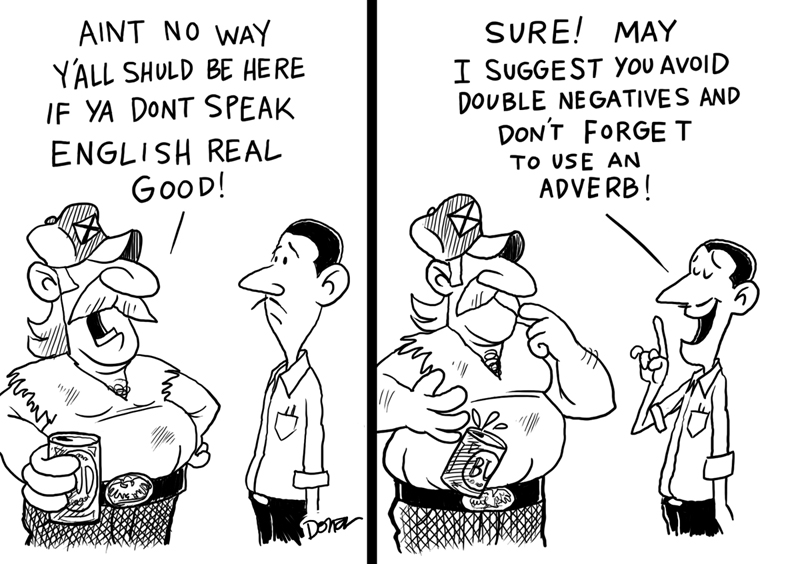
This political cartoon caught my eye and really reminded me of the book written by Leo Chavez, "The Latino Threat." This cartoon really personifies the argument that Chavez was making in his book; how Latinos have been alienated and labeled to be one way. I love how this cartoon represents the stereotype and then so quickly rejects it. It is an excellent example of many people's attitudes towards immigrants and further, an example of how such attitudes are quite unjust.
Sunday, December 5, 2010
The United States 'Volatile' Population
I found an article that was interesting regarding immigration and its effects on the population of the United States. According to Haya El Nasser, the nation's population was determined to be 281.4 million in the 2000 Census, but early estimates of the 2010 Census indicate lower numbers; 305.7 million people.
This year is the first one that the agency has put out five estimates "based on Census survey and administrative records such as births, deaths and immigration" (Nasser). These estimates, according to Nasser, are reflective of the widespread changes regarding immigration that have taken place between 2000 and 2010.
I think it is interesting that the Census is reporting smaller population numbers for the 2010 Census and wonder just how much of the change can be attributed to legislation like Arizona's SB 1070. It will be interesting to see the actual results of the Census later this month and just how they correlate to changes that have taken place over the last decade.
Follow-up
On December 4, Scott Wong wrote a short piece regarding the DREAM Act and how the Senate would be holding a vote in the coming week on it. The votes being held next week in addition to the DREAM Act are on "immigration, a health care bill for 9/11 rescue workers and a cost-of-living adjustment for seniors" (Wong). According to Reid, it "leaves a pretty clear path to tackle larger issues like tax cuts, a government spending bill, ratification of the START nuclear-arms treaty, and possibly the massive defense bill which includes the repeal of "don't ask, don't tell" policy" (Wong).
The DREAM Act must receive sixty votes in order to advance in the Senate, but a number or Republicans have vowed this week that they would "block any legislation brought up before the chamber deals with expiring Bush-era tax cuts and funding for government operations" (Wong). Wong also pointed out that "in recent days, calls from the Obama administration, the Hispanic community and immigrant advocates" have intensified in urging congressional action on the bill.
Revisiting the DREAM Act
Brian Montopoli wrote an article entitled, "Is There a Last Gasp for Immigration Reform?" on December 1. Within his article he discusses how the DREAM Act is essential to any immigration reform and talks about what the Democrats have to do to get the vote to the Senate. According to Montopoli, "The DREAM Act is a major priority of Hispanic groups, who represent a growing and crucial voting bloc. [He goes on to say that] without them Senate Majority Leader Harry Reid, among other Western Democrats, would now be preparing for retirement."
It is going to be a challenge to bring the DREAM Act for a vote in the Senate, "Republicans say they will block any and all other legislation until the Bush tax cuts have been extended and the government, which runs out of money on Friday, has been funded" (Montopoli). The bill needs sixty votes in order to pass and that is still in the air, at least two of the Democrats will likely vote against it which will only offset the two Republicans that seem to support the bill. In order for Reid to overcome a filibuster two more Republicans would have to vote for it. It is also not yet a "sure thing in the House: Democrat Steny Hoyer said today that he has not yet determined whether or not is will come to the floor, and even if it does, expect a number of Democrats to vote against it" (Montopoli).
Although it seems unlikely that it will pass as of right now, I do think that the Democrats should continue to push for the Senate and House vote. I think that if it is passed it would prove to be quite beneficial to the United States. It would be providing a path to citizenship to those people that have been in America since they were young children, have not committed any serious crimes, and have gone to school with the ultimate goal of college or the military. It seems to me that these people would be ones that we want to be American citizens, people who are quite valuable to society as a whole.
Monday, November 29, 2010
Prince William Immigration Law
Three years ago Prince William County in Virgina passed an ordinance "which initially required police to check the status of detainees they suspected of being undocumented immigrants" (Bahrampour). This ordinance received many of the same responses that the Arizona law does. It has "raised ire among immigrant advocates and [has drawn] sharp criticism from the county police chief, who said it would cost taxpayers more, lead to allegations of racism and erode police-community relations" (Bahrampour).
The ordinance was modified in 2008 as it was charged as "unconstitutional and could lead to racial profiling" (Bahrampour). The modification directed officers to question all criminal suspects regarding their immigration status once arrested, rather than only questioning those suspected of being illegal immigrants.
On November 17, 2010 an article was published looking into the Prince William policy and the effect it has had over the years. According to a report for the University of Virginia, the policy "appears to have had some effect, as the growth of the county's Hispanic population now lags behind that of other jurisdictions" (Buske).
"The three-year, $385,000 study- released Tuesday by the university's Center for Survey Research- also found that the country's noncitizen Hispanic population, legal and illegal, dropped by 7,700 from 2006 to 2008, and that illegal immigrants accounted for 2,000 to 6,000 of that decline" (Burske).
Prior to the ordinance, the county had significant growth in its Hispanic population, in fact, it "almost doubled from 2000 to 2005" (Burske). Although growth leveled off in the county once the policy was implemented, growth continued in Washington overall. "The report states that Hispanics are avoiding Prince William and that the county, therefore, did not succeed in implementing an immigration policy without damaging its reputation as a welcoming place to live" (Burske).
The report goes on to state that while the policy has reduced the number of illegal immigrants in Prince William, not all of the effects have been "good". "Initial distrust of and dissatisfaction with county government has subsided among Hispanic residents of Prince William. The change in attitude can be attributed to adjustments in the policy, community outreach and the decline in attention paid by the media and groups opposing illegal immigration" (Burske).
Although "the study found that initial fears about racial profiling did not materialize and that only one lawsuit that mentions racial profiling has surfaced" (Burske) (which was ultimately dismissed in court), a Spanish radio show host voiced his disagreements. Accroding to Aragon, " There was racial profiling, and that's the reason why everyone started to leave [and that] the Hispanic businesses and malls are empty. [He said] you used to see 100 people at the shopping center, and after the resolution, you'd see five. You noticed the difference" (Burske).
Overall, it is interesting to read the effects that such a policy has had over the span of three years. I think it will be quite interesting to look at Arizona statistics after a few years.
The ordinance was modified in 2008 as it was charged as "unconstitutional and could lead to racial profiling" (Bahrampour). The modification directed officers to question all criminal suspects regarding their immigration status once arrested, rather than only questioning those suspected of being illegal immigrants.
On November 17, 2010 an article was published looking into the Prince William policy and the effect it has had over the years. According to a report for the University of Virginia, the policy "appears to have had some effect, as the growth of the county's Hispanic population now lags behind that of other jurisdictions" (Buske).
"The three-year, $385,000 study- released Tuesday by the university's Center for Survey Research- also found that the country's noncitizen Hispanic population, legal and illegal, dropped by 7,700 from 2006 to 2008, and that illegal immigrants accounted for 2,000 to 6,000 of that decline" (Burske).
Prior to the ordinance, the county had significant growth in its Hispanic population, in fact, it "almost doubled from 2000 to 2005" (Burske). Although growth leveled off in the county once the policy was implemented, growth continued in Washington overall. "The report states that Hispanics are avoiding Prince William and that the county, therefore, did not succeed in implementing an immigration policy without damaging its reputation as a welcoming place to live" (Burske).
The report goes on to state that while the policy has reduced the number of illegal immigrants in Prince William, not all of the effects have been "good". "Initial distrust of and dissatisfaction with county government has subsided among Hispanic residents of Prince William. The change in attitude can be attributed to adjustments in the policy, community outreach and the decline in attention paid by the media and groups opposing illegal immigration" (Burske).
Although "the study found that initial fears about racial profiling did not materialize and that only one lawsuit that mentions racial profiling has surfaced" (Burske) (which was ultimately dismissed in court), a Spanish radio show host voiced his disagreements. Accroding to Aragon, " There was racial profiling, and that's the reason why everyone started to leave [and that] the Hispanic businesses and malls are empty. [He said] you used to see 100 people at the shopping center, and after the resolution, you'd see five. You noticed the difference" (Burske).
Overall, it is interesting to read the effects that such a policy has had over the span of three years. I think it will be quite interesting to look at Arizona statistics after a few years.
Recent High School Graduate
In Reading, Ohio 18 year old Bernard Pastor who graduated last year from high school was arrested last week after he was caught driving without a license. According to Pastor's lawyer, Firooz Namei "Pastor and his family came to America from Guatemala when he was three for religious asylum but was denied in 2001. His family has been in the appeal process since... he has not been in contact with the family because they are in hiding for fear of also being taken into ICE custody and possibly deported" (Fox).
If the Department of Homeland Security agrees to reopen the family's case, he will be able to remain here. Pastor, according to the school superintendent, "was a 4.0 student, played soccer and never caused any trouble." Pastor's potential removal was "delayed Tuesday night after local politicians urged the government to reconsider his case" (Fox).
"The DREAM Act would allow a six year period for young undocumented immigrants to earn a permanent visa and work toward a U.S. citizenship" (Fox). According to Congressman Steve Driehaus, (unseated by Republican Steve Chabot in midterms) the legislation would protect people like Pastor who pose no threat to the country- unlike those criminally convicted that I discussed in a previous entry.
I hope that Pastor is allowed to remain in the country, he has been here since he was three, he has attended school here and ought to be granted citizenship. If he is granted citizenship he will be able to further contribute to society through paying taxes and being a legal, active citizen.
Sunday, November 21, 2010
Deportees Caught in Dragnet
On November 19, 2010 an article was published regarding "a four-day immigration dragnet stretching from the suburbs north of New York City to eastern Long Island" (Semple). A total of 54 illegal immigrants were arrested by federal law-enforcement officers. All of the illegal immigrants had been previously been deported with criminal records, but "secretly re-entered the country" (Semple).
According to Semple, "the tally was the largest number of once-deported immigrants ever ensnared in a single operation by immigration agents." Over the last 12 months immigration authorities have deported a record number of immigrants, "more than 195,700 of the deportees, or about half of the total, were convicted criminals" (Semple). Under the Bush administration, "about 32 percent of all deported immigrants were criminals" (Semple).
Suspects included people convicted of sexual assault involving a child as well as those involving assault with a weapon. I think that it is really good that the federal agents focus more so on illegal immigrants that are committing crimes in the country.
According to Semple, "the tally was the largest number of once-deported immigrants ever ensnared in a single operation by immigration agents." Over the last 12 months immigration authorities have deported a record number of immigrants, "more than 195,700 of the deportees, or about half of the total, were convicted criminals" (Semple). Under the Bush administration, "about 32 percent of all deported immigrants were criminals" (Semple).
Suspects included people convicted of sexual assault involving a child as well as those involving assault with a weapon. I think that it is really good that the federal agents focus more so on illegal immigrants that are committing crimes in the country.
Illegal Workers in Australia
Today I came across an article with an audio file regarding illegal immigrants in Western Australia. In the discussion a worker from the Department of Immigration, Sian Manton speaks of the sting that took place this month in an orchard just outside of the town Gingin.
A local tipped off the Department of Immigration which led to a roadside traffic stop in which two vans on the way to the orchard were stopped and then illegal workers were detained. Of the people detained, 24 were Malaysian and 3 were from Indonesia. 11 of the people had overstayed their visas, 16 had visas that did not give them the right to work; all of the people are in detention and will be sent back home. All of the immigrants arrived by air with legal visas, whether short-term or not.
I thought this was a pretty interesting article to compare to the illegal immigration in America. I am curious about statistics regarding how many people in America overstay their visas to work. I also wonder how many people plan to follow their visa's regulations initially, but come across economic incentives which lead them to overstay their visas.
A local tipped off the Department of Immigration which led to a roadside traffic stop in which two vans on the way to the orchard were stopped and then illegal workers were detained. Of the people detained, 24 were Malaysian and 3 were from Indonesia. 11 of the people had overstayed their visas, 16 had visas that did not give them the right to work; all of the people are in detention and will be sent back home. All of the immigrants arrived by air with legal visas, whether short-term or not.
I thought this was a pretty interesting article to compare to the illegal immigration in America. I am curious about statistics regarding how many people in America overstay their visas to work. I also wonder how many people plan to follow their visa's regulations initially, but come across economic incentives which lead them to overstay their visas.
Denial?
Today I was browsing immigration news and came across an article entitled, In Denial Over Immigration: we may criticize illegals- but we enjoy the benefits. The article discussed how illegal immigration has come to be such a "hot-button topic"- especially among politicians and voters. The author then describes a "dirty little secret- that too many of us benefit from illegal immigration to do something about it."
To briefly summarize the article's argument, Americans on the "outside", or in theory, oppose illegal immigration, but in reality enjoy its benefits far more than they let on- benefits like "low grocery prices and cheap yard work and housecleaning services".
The article concluded with propositions of immigration reform which are listed bellow;
"We have long supported a comprehensive immigration reform that deals with the major challenges. That reform should include:
Read more: http://www.modbee.com/2010/11/20/1437902/in-denial-over-immigration.html#ixzz15zYqtx9b"
To briefly summarize the article's argument, Americans on the "outside", or in theory, oppose illegal immigration, but in reality enjoy its benefits far more than they let on- benefits like "low grocery prices and cheap yard work and housecleaning services".
The article concluded with propositions of immigration reform which are listed bellow;
"We have long supported a comprehensive immigration reform that deals with the major challenges. That reform should include:
• Enhanced border security to limit the growth of illegal immigration. That would also make our nation safer from terrorists intent on doing damage to our country.
• A fair guest-worker program that provides a reliable pool of workers to industries that need foreign laborers.
• A means for those already here illegally to earn legal residency if they meet strict requirements, including paying fines and showing they have had a responsible work history.
President George W. Bush offered a wise reform package in 2007. But it fell apart in the Senate when Republicans and Democrats alike blocked it. They simply didn't want to fix the broken system because both parties had constituencies that benefited from maintaining the status quo.
Read more: http://www.modbee.com/2010/11/20/1437902/in-denial-over-immigration.html#ixzz15zYqtx9b"
What really interested me about this article were the responses it got, many of them truly surprised me. One comment definitely stuck out and seemed to demonstrate so many misconstrued beliefs in a very short space:
BS, BS, and BS again. I won't go to a carwash that employes Hispanics; corporate farms DO NOT PASS ON SAVINGS TO THE CONSUMER. The American taxpayer pays a huge price for a fruit to be picked. Give us the opportunity, and we'll pick our own. I do. Oh yes, I clean my own home and would flatly refuse to allow a Hispanic into my home considering the millions who are here illegally. I, nor most Americans, "enjoy" benefits from the millions of welfare class invaders.
Read more: http://www.modbee.com/2010/11/20/1437902/in-denial-over-immigration.html#ixzz15zZU3Czs
Read more: http://www.modbee.com/2010/11/20/1437902/in-denial-over-immigration.html#ixzz15zZU3Czs
That comment was posted by someone under the name, "sickofspics"- which, much like the comment, left me speechless. "Spic" is a racial slur for a person of Hispanic descent and I just cannot believe that people legitimately throw the word around without having a second thought about it.
I think that this relates very well to Leo Chavez's text where he describes how the Hispanic population as a whole has been generalized into one and alienated. The person that posted the comment above under such a derogatory name is propelling the same phenomena that the general public is promoting when referring to immigrants as aliens; dehumanizing them.
I also think it is worth noting how the person commenting argues, "Give us the opportunity, and we'll pick our own. I do." I have to question the truth in the "I do", I just think that too many Americans argue that point, but do not back it up at all. Additionally, stating that they "would fatly refuse to allow a Hispanic into [their] home considering the millions who are here illegally" is again, a huge generalization and comes across as quite ignorant.
Overall, while I do think that the article was quite interesting and did speak truth, the comments (the one above in particular) really amazed me and seemed to run right in line with Leo Chavez's book. It is very sad to me that in this day and age people continue to use such hateful language, especially in regard to speaking to/about fellow human beings.
Sunday, November 14, 2010
Secure Communities
The Secure Communities strategy is one that allows information to be shared between the United States Department of Homeland Security and the Department of Justice. According to the United States Immigration and Customs Enforcement website, the information sharing helps to "quickly and accurately identify aliens who are arrested for a crime and booked into local law enforcement custody. With this capability, the fingerprints of everyone arrested and booked are not only checked against FBI criminal history records, but they are also checked against DHS immigration records." Ultimately, it the fingerprints match records, it is determined if immigration enforcement action is required- immigration status is considered along with the crime and any criminal history.
Today an article was published by the Mercury News regarding the Secure Communities strategy and how the Fed will not allow Santa Clara Country to opt out of the program. According to Mercury News, the program has "led to the deportation of nearly 47,000 illegal immigrants nationwide since it was introduced just over a year ago." The article also states that "although the program is meant to focus on undocumented residents who've been convicted of murder, rape and other serious crimes, opponents say it's snared people jailed for low-level offenses such as traffic violations. They also say it's led to racial profiling and has made immigrants afraid to report other crimes, such as domestic violence." In the end, the states decision about the program overrides the individual counties decisions.
Today an article was published by the Mercury News regarding the Secure Communities strategy and how the Fed will not allow Santa Clara Country to opt out of the program. According to Mercury News, the program has "led to the deportation of nearly 47,000 illegal immigrants nationwide since it was introduced just over a year ago." The article also states that "although the program is meant to focus on undocumented residents who've been convicted of murder, rape and other serious crimes, opponents say it's snared people jailed for low-level offenses such as traffic violations. They also say it's led to racial profiling and has made immigrants afraid to report other crimes, such as domestic violence." In the end, the states decision about the program overrides the individual counties decisions.
Friday, November 12, 2010
Yuma, the Farmland

The first few times I visited Yuma I noticed that I was part of the minority, the Mexican food was amazing, and that there were a lot of farms. Eventually I started to pay more attention to the vast farmlands and the white buses that seemed to be abundant. The white buses all have two "port-a-potties" attached to them; these buses are parked on the edges of the fields. It took me a few times to really notice all of the workers from said buses lining the fields, walking the rows and picking the crop.
Now, every morning when I drive by the fields I watch as the workers walk the fields and wonder where they are from-Mexico? I have been told that the workers are from Mexico and that they line up each morning on the boarder to be picked up, work all day (7am-4/5/6pm), then go back home. I tried to look up this information, but really had no luck. It is plausible here in Yuma where the border is a short ride away. I also found this article which talks about working on the lettuce farms in Yuma.
Gabriel Thompson is interviewed about his experiences working in the Yuma lettuce fields, along with working in an Alabama chicken processing plant. Throughout his interview, Thompson explains that a typical day on a lettuce field in Yuma beings around 7:30 in the morning and ends around six at night, and "during the course of a day [he] could be asked to cut about 3,000 heads [of lettuce]." He also expressed how he did not ever see another white person in the fields, which I found to be interesting and not surprising. It has been argued many a time that illegal immigrants take jobs (like that on a lettuce field), these jobs are argued to be ones that Americans would ordinarily take (if the immigrants were not taking them, of course). To me this argument seems quite illogical and really inaccurate, especially after reading of Thompson's experiences on the fields. If Americans truly were willing to take these strenuous jobs, they would, but in reality "there [are not] very many Americans who are going to want to do these kinds of jobs." In conclusion, I tip my hat (or imaginary hat really) to the workers and their hard work, fully aware that I would probably not last one day in their shoes.
Sunday, November 7, 2010


Tuesday, November 2, 2010
Constitutionality of Arizona Immigration Law
Arizona's immigration law was argued over by Federal judges yesterday (November 1). Here is the article
The article is brief and discusses the protests that were held outside of Federal buildings on Monday. Protesters argued that SB 1070 "violates equal protection and the constitution and violates First Amendment free-speech concerns" (Nazario, 2010).
"South Asian organizer Hamid Khan says SB 1070’s underlying message is that undocumented immigrants threaten national security. "And hence they are always suspect. That kinda takes every community into its fold, whether you’re Pakistani, whether you’re Chicano, whether you’re from Korea.”" (Nazario, 2010). This statement made me think of Leo Chavez's text, The Latino Threat and when he discussed how after September 11 the United States- Mexico boarder emerged as a "new threat"- a "gateway through which possible terrorists might enter" (2008, p.36).
It seems as though that belief has persisted to some extent and I think that Nazario's article exemplifies it. When these views are argued, they tend to place labels onto large groups of immigrants, many of these labels extending from generalizations. I do not think it is fair that illegal immigrants be labeled as threats to national security, it simply fuels arguments that they are trying to essentially "invade" our country and take over with their culture, thus threatening our national identity- this is of course far from reality.
The article is brief and discusses the protests that were held outside of Federal buildings on Monday. Protesters argued that SB 1070 "violates equal protection and the constitution and violates First Amendment free-speech concerns" (Nazario, 2010).
"South Asian organizer Hamid Khan says SB 1070’s underlying message is that undocumented immigrants threaten national security. "And hence they are always suspect. That kinda takes every community into its fold, whether you’re Pakistani, whether you’re Chicano, whether you’re from Korea.”" (Nazario, 2010). This statement made me think of Leo Chavez's text, The Latino Threat and when he discussed how after September 11 the United States- Mexico boarder emerged as a "new threat"- a "gateway through which possible terrorists might enter" (2008, p.36).
It seems as though that belief has persisted to some extent and I think that Nazario's article exemplifies it. When these views are argued, they tend to place labels onto large groups of immigrants, many of these labels extending from generalizations. I do not think it is fair that illegal immigrants be labeled as threats to national security, it simply fuels arguments that they are trying to essentially "invade" our country and take over with their culture, thus threatening our national identity- this is of course far from reality.
Tuesday, October 26, 2010
Social Media- Reliable Information?
According to Sarah Buduson, a Phoenix reporter for KPHO news, "Federal employees are using social network websites to investigate immigration fraud among petitioners who want to gain citizenship through fake marriages" (2010). Buduson explains throughout the article how it is quite easy to become friends with strangers through social media, which ultimately allows for a great deal of personal information to be made public.
Although U.S. Citizenship and Immigration Services spokesperson, Chris Bentley "denied the agency dupes green card applicants or others immigration petitioners into making connections on social network sites" (2010), it is an interesting concept to consider. It is also worth noting that at the end of the article, Buduson reports that a different U.S. Department of Homeland Security spokesman, Matt Chandler said that they do in fact "look at public information on social networking websites to investigate green card applications" (2010).
As social media has become more popular, companies have found it to be a useful means of obtaining information about potential employees- information that they would otherwise have a hard time getting. It does seem like an invasion of privacy, but is it? It is your personal information, but you are also the one putting it out in the open, thus putting yourself into a potentially vulnerable position. When information about yourself is put onto social media sites, many people can learn quite a bit about you- often without your knowing.
Ultimately, I think it is pretty interesting that Federal employees may be using social media to determine whether a marriage is real or fake for immigration purposes, but question how reliable such information could be in a case in court. I also am torn on how I feel about the issue, on one hand, I think it is wrong to probe social network sites for such information in order to use it as basis for deciding whether someone ought to be granted or denied citizenship. On the other hand, I think that people should be more conscientious when publishing personal information online and should consider the audience that has access to such information.
http://www.kpho.com/news/25510617/detail.html
Although U.S. Citizenship and Immigration Services spokesperson, Chris Bentley "denied the agency dupes green card applicants or others immigration petitioners into making connections on social network sites" (2010), it is an interesting concept to consider. It is also worth noting that at the end of the article, Buduson reports that a different U.S. Department of Homeland Security spokesman, Matt Chandler said that they do in fact "look at public information on social networking websites to investigate green card applications" (2010).
As social media has become more popular, companies have found it to be a useful means of obtaining information about potential employees- information that they would otherwise have a hard time getting. It does seem like an invasion of privacy, but is it? It is your personal information, but you are also the one putting it out in the open, thus putting yourself into a potentially vulnerable position. When information about yourself is put onto social media sites, many people can learn quite a bit about you- often without your knowing.
Ultimately, I think it is pretty interesting that Federal employees may be using social media to determine whether a marriage is real or fake for immigration purposes, but question how reliable such information could be in a case in court. I also am torn on how I feel about the issue, on one hand, I think it is wrong to probe social network sites for such information in order to use it as basis for deciding whether someone ought to be granted or denied citizenship. On the other hand, I think that people should be more conscientious when publishing personal information online and should consider the audience that has access to such information.
http://www.kpho.com/news/25510617/detail.html
Monday, October 25, 2010
'DON'T VOTE'...One Step Forward or Two Steps Back??
http://www.latimes.com/la-ed-latinos-20101021,0,3011817.story?track=rss
- On October 21, 2010 an article was published regarding a new attack ad in Nevada's Senate race. The attack ad is one from the group Latinos for Reform, the ad essentially tells Latino voters not to vote. According to Peter Overby, "it accuses both parties of neglecting Latinos- but it dwells on Democrats. It says Democratic leaders including Harry Reid are taking Hispanic voters for granted. It says not voting is the only way to get Democrats to take them seriously" (2010).
The ad producer, Robert Deposada insists that the ad is not telling Latinos to sit out of elections, but rather to "boycott politicians who haven't lived up to their promises" (2010). Instead of the ad ending with this statement, 'Don't vote for those who betrayed you', it ended with 'Don't vote' because of time constraints. According to the director of the League of United Latin American Citizens (LULAC), Brent Wilkes, Deposada's argument does not hold. He argued that, "It's just not believable. I mean, the whole ad is about 'don't vote, stay home.' It's not only the words but the pictures they show" (2010).
I think that the 'Don't vote' ad is counteractive in getting the Latino voice heard. According to Leo Chavez, one feature of citizenship is being able to act within the political realm (2008, pp.13). If Latinos decide against voting, how can they truly expect their voices to be heard when they are neglecting one of their most essential rights of being a citizen. Brent Wilkes of LULAC also points out that Republicans and Democrats are not very likely to "pay much attention to Latinos if they're not voting" (2010). Overall, it seems that the group, Latinos for Reform failed to assess how negatively such an ad could impact their very cause- if Latinos fail to participate in the elections their voices could be easily overpowered by those that choose to vote.
I think that the 'Don't vote' ad is counteractive in getting the Latino voice heard. According to Leo Chavez, one feature of citizenship is being able to act within the political realm (2008, pp.13). If Latinos decide against voting, how can they truly expect their voices to be heard when they are neglecting one of their most essential rights of being a citizen. Brent Wilkes of LULAC also points out that Republicans and Democrats are not very likely to "pay much attention to Latinos if they're not voting" (2010). Overall, it seems that the group, Latinos for Reform failed to assess how negatively such an ad could impact their very cause- if Latinos fail to participate in the elections their voices could be easily overpowered by those that choose to vote.
Saturday, October 23, 2010
Canadians and Europeans OK...
On October 20, Elise Foley wrote an article entitled, Florida Immigration Bill Allows Police to Skip Over Canadians, Europeans. The Florida bill mimics Arizona's SB 1070 which "require[s] police to check legal status on anyone they "reasonably" suspec[t] of being in the country illegally if the police have already stopped them" (2010). The Florida bill also requires similar actions by their police, but allows them to assume the status of Canadians along with that of people from Western Europe (if they have a passport from said country). It has been argued that the provision clearly allows police to legally target a specific minority.
Representative William Snyder drafted Florida's bill and said "the language was meant to avoid deterring tourism from Canada. "What we're doing there is trying to be sensitive to Canadians"" (2010). He goes on to describe the bill's language as 'comfort' language.
Through reading this article I find it difficult to fully understand, or agree with William Snyder's reasonings for allowing "Canadians and Western Europeans to be presumed to be legally in the United States (2010), while non-citizens from other countries must carry around papers. Ultimately, I think it is absurd for Florida to propose such a seemingly discriminatory bill. I do not think that they should be targeting specific populations, while clearly excluding others. I think that this bill could potentially deter tourism from people that are not from Canada or Western Europe simply because they are at greater risk. In the end, I simply disagree with the language of this bill and think it should be scrapped based on that alone.
http://washingtonindependent.com/101195/florida-immigration-bill-allows-police-to-skip-over-canadians-europeans
Representative William Snyder drafted Florida's bill and said "the language was meant to avoid deterring tourism from Canada. "What we're doing there is trying to be sensitive to Canadians"" (2010). He goes on to describe the bill's language as 'comfort' language.
Through reading this article I find it difficult to fully understand, or agree with William Snyder's reasonings for allowing "Canadians and Western Europeans to be presumed to be legally in the United States (2010), while non-citizens from other countries must carry around papers. Ultimately, I think it is absurd for Florida to propose such a seemingly discriminatory bill. I do not think that they should be targeting specific populations, while clearly excluding others. I think that this bill could potentially deter tourism from people that are not from Canada or Western Europe simply because they are at greater risk. In the end, I simply disagree with the language of this bill and think it should be scrapped based on that alone.
http://washingtonindependent.com/101195/florida-immigration-bill-allows-police-to-skip-over-canadians-europeans
Tuesday, October 19, 2010
Germany and Immigration
Today I read an article about Germany (and much of Europe) and their increasingly anti-immigration disposition. Their Chancellor Angela Merkel declared that Germany's "attempts to create a multicultural society have utterly failed" (2010). She went on to say that "new arrivals need to do more to integrate into German society" (2010). When I read this article I kept thinking about how familiar the arguments sounded; the arguments made by some Germans regarding immigrant groups (especially Turkish people and Muslims) to their country seem to parallel arguments that are made by some Americans regarding Latino immigration.
Americans frequently argue that Hispanic immigrants continue to fail at truly integrating into American society. People arguing this point often refer to language differences and argue further that Hispanics are either not learning English fast enough, or simply do not want to learn it at all. This argument clearly influences Angela Merkel when she speaks about immigrants in Germany. Through her speech she declared that "immigrants need to learn to speak German in order to do better in school and integrate" (2010).
Another argument that has sprouted in Germany regarding immigration is discussed in the book, Germany Does Away with Itself by Thilo Sarrazin. This book "argues that Muslim immigrants are sponging off welfare and undermining Germany's culture, economy and way of life" (2010). This argument has been used frequently through history regarding immigrants in America. For example, in an article entitled, "Immigrants Find no Need to Learn English", Sam Francis argues not only that the current wave of Hispanic immigrants are not integrating into American culture as earlier immigrant waves have, but they are also bringing in "quaint Third World customs [such as] child marriage, female genital mutilation, and alien religions that are little more than voodoo and black magic" (2008).
Further into the article a vice president with the Social Democrats, Manuela Schwesig "called Merkel's speech a shameless embrace of a Seehofer-style black-and-white debate about immigration, instead of really addressing the problems" (2010). Schwesig's statement made me think of a recent discussion that we had in class where we concluded that it is often policy that causes said 'problems', not the immigrants themselves as being argued by many Americans and Merkel.
It is worth pointing out the irony of Germany's immigration debate, while they are presenting anti-immigration views, they "desperately need more skilled workers" (2010). Through American history, times of economic boom have demanded more workers which have led to increased demand of immigrant labor, but this does not seem to be the case in Germany. "Germany still has some of the toughest immigration and citizenship laws in the European Union. Those regulations are hurting its fast-moving high-tech businesses" (2010).
In the end, it is evident that Germany and America often speak of their immigrants in a similar manner which indicates the need for policy change along with overall attitude change. Immigrants may feel German or American, but be viewed by many native-born Germans or Americans as immigrants invading their society. This view ultimately drives myths concerning immigrants, these myths that assume a great deal and more often than not, shed negative light on immigrants.
Here is the link to the article: http://www.npr.org/templates/story/story.php?storyId=130649146&f=1001&sc=tw&utm_source=twitterfeed&utm_medium=twitter
Americans frequently argue that Hispanic immigrants continue to fail at truly integrating into American society. People arguing this point often refer to language differences and argue further that Hispanics are either not learning English fast enough, or simply do not want to learn it at all. This argument clearly influences Angela Merkel when she speaks about immigrants in Germany. Through her speech she declared that "immigrants need to learn to speak German in order to do better in school and integrate" (2010).
Another argument that has sprouted in Germany regarding immigration is discussed in the book, Germany Does Away with Itself by Thilo Sarrazin. This book "argues that Muslim immigrants are sponging off welfare and undermining Germany's culture, economy and way of life" (2010). This argument has been used frequently through history regarding immigrants in America. For example, in an article entitled, "Immigrants Find no Need to Learn English", Sam Francis argues not only that the current wave of Hispanic immigrants are not integrating into American culture as earlier immigrant waves have, but they are also bringing in "quaint Third World customs [such as] child marriage, female genital mutilation, and alien religions that are little more than voodoo and black magic" (2008).
Further into the article a vice president with the Social Democrats, Manuela Schwesig "called Merkel's speech a shameless embrace of a Seehofer-style black-and-white debate about immigration, instead of really addressing the problems" (2010). Schwesig's statement made me think of a recent discussion that we had in class where we concluded that it is often policy that causes said 'problems', not the immigrants themselves as being argued by many Americans and Merkel.
It is worth pointing out the irony of Germany's immigration debate, while they are presenting anti-immigration views, they "desperately need more skilled workers" (2010). Through American history, times of economic boom have demanded more workers which have led to increased demand of immigrant labor, but this does not seem to be the case in Germany. "Germany still has some of the toughest immigration and citizenship laws in the European Union. Those regulations are hurting its fast-moving high-tech businesses" (2010).
In the end, it is evident that Germany and America often speak of their immigrants in a similar manner which indicates the need for policy change along with overall attitude change. Immigrants may feel German or American, but be viewed by many native-born Germans or Americans as immigrants invading their society. This view ultimately drives myths concerning immigrants, these myths that assume a great deal and more often than not, shed negative light on immigrants.
Here is the link to the article: http://www.npr.org/templates/story/story.php?storyId=130649146&f=1001&sc=tw&utm_source=twitterfeed&utm_medium=twitter
Monday, October 11, 2010
Car Crash Brought Up Within Immigration Debate
http://www.environmentalprograms.net/guidance/eco-econ/#prof
On September first an article was published by USA Today entitled, "Fatal Crash Latest Flashpoint in Immigration Debate". The article discusses an illegal immigrant that is "charged with drunken driving in a crash that killed a nun and critically injured two others[, he] could face a felony murder charge in the case" (Gomez, 2010). The fact that the driver was an illegal immigrant led some groups of people to cite it "as an example of a failed policy that allows illegal immigrants to stay in the United States" (2010).
The article quoted spokesman Bob Dane from the Federation for American Immigration Reform stating that, "this guy would have been identified as being an illegal alien several violations and incarcerations ago, and he would be back in his home country. He wouldn't be driving without a license and killing people" (2010), if America's immigration policy were reformed.
When I read this I thought of the book, A Latino Threat by Leo Chavez and how Mexicans have come to be associated with the term illegal alien (2008, p.24). This statement is also a good example of how Latin American immigrants have been essentially "turned into statistical means" (Chavez, 2008, p.43). The statement made by Dane singles out immigration policy as the root cause of the fatalities caused by the crash- not the fact that the man was driving drunk. (Not to mention the fact that drunk driving is a prevalent problem across all nationalities, genders, and races)
The Benedictine Sisters of Virginia were quoted later in the article expressing "that they were "dismayed and saddened that [the] tragedy [had] been politicized and become an apparent forum for the illegal-immigration agenda"" (Gomez, 2010). The president of American Immigration Lawyers Association, David Leopold also stated that "[the] issue in this case [was] not that an undocumented driver was driving drunk. The issue is drunk driving, period. There is not a problem in this country with any particular ethnic group. It is a national problem from state to state" (2010). I think that both of these statements indicate positive movement away from such generalizations of Latin American immigrants that Leo Chavez discusses which Dane exemplified.
Overall, I think it is interesting and unfortunate that there are people such as Dane that continue to not only take isolated cases and generalize them across whole populations of people, but additionally continue to use the term illegal alien to define particular ethnic groups- namely Latin Americans. Although using such a term may seem minuscule in regards to its effect on society overall, its continuous use embeds the idea into people's minds where it is eventually internalized. When ideas like that of a person being an illegal alien to a particular country are internalized the virtual lives of the aliens overshadow their actual lives. This has clearly happened with regards to Mexican and other Latin American immigrants over the years.
"Once constructed in this way, Mexican and other Latin American immigrants and even United States- born Latinos, are ready to be represented as "space invaders"- as Nirmal Puwar has put it- whose reproduction both social and biological, threatens to destroy the nations identity" (Chavez, 2008, p.40).
On September first an article was published by USA Today entitled, "Fatal Crash Latest Flashpoint in Immigration Debate". The article discusses an illegal immigrant that is "charged with drunken driving in a crash that killed a nun and critically injured two others[, he] could face a felony murder charge in the case" (Gomez, 2010). The fact that the driver was an illegal immigrant led some groups of people to cite it "as an example of a failed policy that allows illegal immigrants to stay in the United States" (2010).
The article quoted spokesman Bob Dane from the Federation for American Immigration Reform stating that, "this guy would have been identified as being an illegal alien several violations and incarcerations ago, and he would be back in his home country. He wouldn't be driving without a license and killing people" (2010), if America's immigration policy were reformed.
When I read this I thought of the book, A Latino Threat by Leo Chavez and how Mexicans have come to be associated with the term illegal alien (2008, p.24). This statement is also a good example of how Latin American immigrants have been essentially "turned into statistical means" (Chavez, 2008, p.43). The statement made by Dane singles out immigration policy as the root cause of the fatalities caused by the crash- not the fact that the man was driving drunk. (Not to mention the fact that drunk driving is a prevalent problem across all nationalities, genders, and races)
The Benedictine Sisters of Virginia were quoted later in the article expressing "that they were "dismayed and saddened that [the] tragedy [had] been politicized and become an apparent forum for the illegal-immigration agenda"" (Gomez, 2010). The president of American Immigration Lawyers Association, David Leopold also stated that "[the] issue in this case [was] not that an undocumented driver was driving drunk. The issue is drunk driving, period. There is not a problem in this country with any particular ethnic group. It is a national problem from state to state" (2010). I think that both of these statements indicate positive movement away from such generalizations of Latin American immigrants that Leo Chavez discusses which Dane exemplified.
Overall, I think it is interesting and unfortunate that there are people such as Dane that continue to not only take isolated cases and generalize them across whole populations of people, but additionally continue to use the term illegal alien to define particular ethnic groups- namely Latin Americans. Although using such a term may seem minuscule in regards to its effect on society overall, its continuous use embeds the idea into people's minds where it is eventually internalized. When ideas like that of a person being an illegal alien to a particular country are internalized the virtual lives of the aliens overshadow their actual lives. This has clearly happened with regards to Mexican and other Latin American immigrants over the years.
"Once constructed in this way, Mexican and other Latin American immigrants and even United States- born Latinos, are ready to be represented as "space invaders"- as Nirmal Puwar has put it- whose reproduction both social and biological, threatens to destroy the nations identity" (Chavez, 2008, p.40).
Monday, October 4, 2010
Immigrants Vs. Natives Within the Workforce
The other day when I signed onto Vista I saw this article posted by Professor Nuno and thought it was very interesting and relevant to current immigration debate. http://www.washingtonpost.com/wp-dyn/content/article/2010/09/24/AR2010092401774.html?nav=most_emailed
I think it is interesting when people complain about immigrants "taking" "our" jobs as it does not seem justified at all, this article does a great job of arguing that.
Last semester I took labor economics and found a research article that discussed what the Washington Post's article addressed along with points regarding the fact that natives actually benefit from immigration. The article entitled The Economic Benefits from Immigration was written by George J. Borjas. According to Borjas, natives mainly benefit from immigration "because of production complementarities between immigrant workers and other factors of production, and that these benefits are larger when immigrants are sufficiently "different" from the stock of native productive inputs" (1995, p.5). Borjas further explains that although benefits are relatively small, the "gains could be increased considerably if the United States pursued an immigration policy that attracted a more skilled immigrant flow" (1995, p.5). (Article is from The Journal of Economic Perspectives; Volume 9, Number 2, pp. 3-22). What Borjas means when he mentions production complementarities between immigrant workers and other factors of production is that they benefit each other and ultimately work to make the other more efficient- they do not work as substitutes- immigrant workers are not replacing native workers, but rather they are complementing them.
Both articles made me think of the movie entitled, "A Day Without a Mexican" which is a ultimately a comedy- but written to address very real points. It was filmed in 2004 and essentially explored the idea of what life in California would be like if all Latino workers refused to work for one day. NPR interviewed Yareli Arizmendi, an actress and co-writer of the film on May 1, 2006 as protests were being planned in effort to change the United States' policy on illegal immigrants. The article can be found at the following address; http://www.npr.org/templates/story/story.php?storyId=5372878
I think it is interesting when people complain about immigrants "taking" "our" jobs as it does not seem justified at all, this article does a great job of arguing that.
Last semester I took labor economics and found a research article that discussed what the Washington Post's article addressed along with points regarding the fact that natives actually benefit from immigration. The article entitled The Economic Benefits from Immigration was written by George J. Borjas. According to Borjas, natives mainly benefit from immigration "because of production complementarities between immigrant workers and other factors of production, and that these benefits are larger when immigrants are sufficiently "different" from the stock of native productive inputs" (1995, p.5). Borjas further explains that although benefits are relatively small, the "gains could be increased considerably if the United States pursued an immigration policy that attracted a more skilled immigrant flow" (1995, p.5). (Article is from The Journal of Economic Perspectives; Volume 9, Number 2, pp. 3-22). What Borjas means when he mentions production complementarities between immigrant workers and other factors of production is that they benefit each other and ultimately work to make the other more efficient- they do not work as substitutes- immigrant workers are not replacing native workers, but rather they are complementing them.
Both articles made me think of the movie entitled, "A Day Without a Mexican" which is a ultimately a comedy- but written to address very real points. It was filmed in 2004 and essentially explored the idea of what life in California would be like if all Latino workers refused to work for one day. NPR interviewed Yareli Arizmendi, an actress and co-writer of the film on May 1, 2006 as protests were being planned in effort to change the United States' policy on illegal immigrants. The article can be found at the following address; http://www.npr.org/templates/story/story.php?storyId=5372878
Subscribe to:
Posts (Atom)